




Why I Trust Solscan as My Go‑To Token Tracker on Solana
Okay, so check this out—Solana moves fast. Really fast. Wow! That speed is thrilling, and also a little terrifying if your block explorer lags. My instinct said: you need a tool that keeps up. Initially I thought any explorer would do, but then I started digging into how token trackers surface mint addresses, holder distributions, and transfer graphs—and that changed things.
Let me be blunt. Not all explorers are created equal. Some show transactions. Some show balances. Few make analytics readable at a glance. Seriously? Yup. Solscan, though, stitches raw chain data into patterns that I can act on. I use it daily when I audit a token or chase liquidity movements. It’s fast, and the UI gives me the right signals without noise, even when I’m skimming between meetings. My first impressions were mostly gut-based. Later I confirmed the details.
Here’s what matters for a token tracker on Solana. Speed, clarity, provenance, and exportability. Short answer: the tracker needs to show token metadata, supply changes, and who the major holders are—quickly. Long answer: you also want transaction timelines, mint/burn events, historical snapshots, and an easy way to pivot from a token to the program or marketplace activity that’s moving it. On one hand you might not care about minute-by-minute internal program logs; on the other, those logs often hide the story of a rug pull or an airdrop pattern. So yeah—look deeper.
What I use Solscan for (and why it works)
When I’m tracking a token, I follow a simple flow. First, confirm the mint. Then check distribution. Next, scan recent large transfers. Finally, verify program interactions. That sequence reduces surprises. Hmm… it sounds obvious, but in practice many explorers scatter those pieces across tabs or bury them behind API calls.
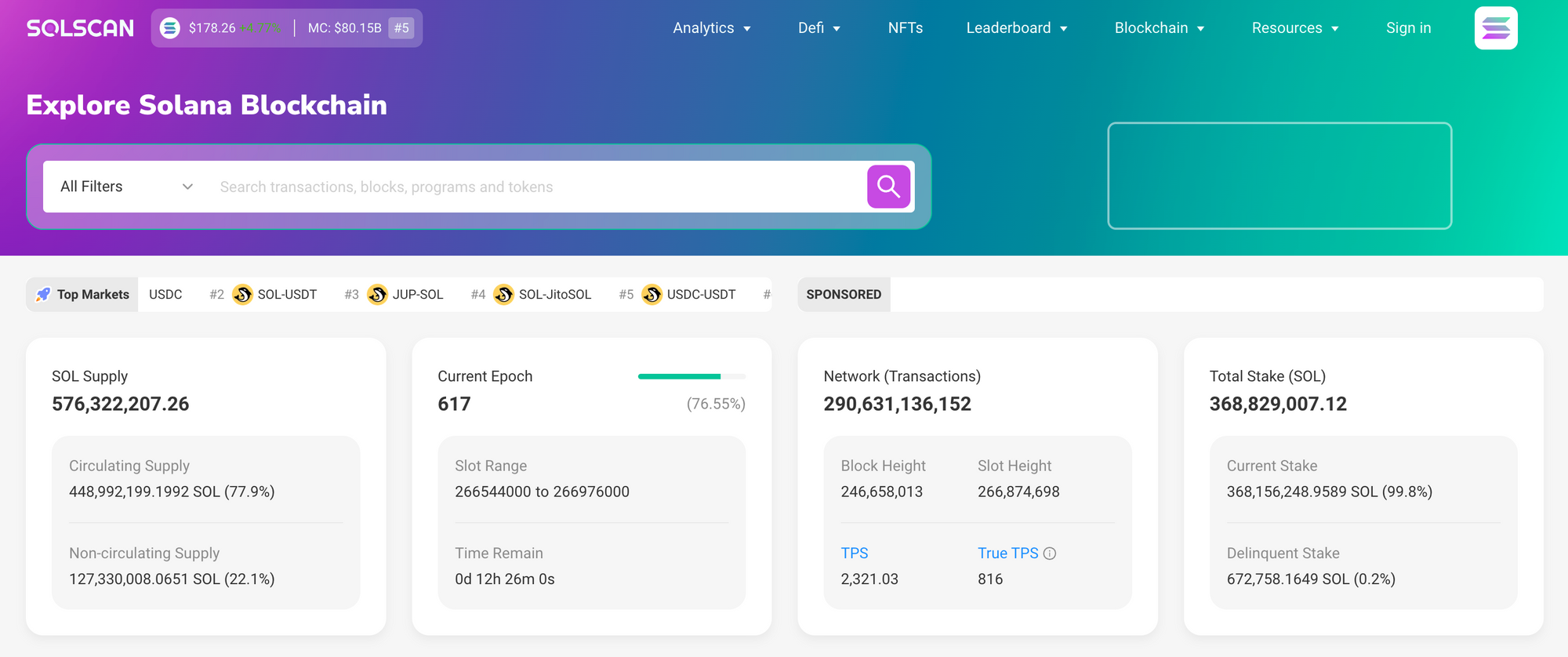
Solscan brings those elements into focus. The token page surfaces metadata and total supply up top. Holder charts and a top‑holder table sit nearby. Transfers and parsed instructions show what’s actually happening inside each transaction, not just who sent what. My approach is pragmatic: if I can answer “who holds the most” and “who moved tokens recently” within 30 seconds, I’m comfortable. Solscan often gets me there. I’m biased, but that speed matters when you’re watching a launch or responding to a suspicious wallet.
One feature that bugs me in other explorers is the lack of context around program calls. Solscan parses and labels instructions so I don’t have to decode raw bytes. That’s a small UX win that saves time. On bigger launches, that time adds up—very very important. Also, the CSV export saves my neck when I need to run quick local analysis or feed data into a spreadsheet for a team discussion.
Security-wise, provenance is king. You want to trace the first mint, all subsequent mints/burns, and any authority changes. Solscan makes the chain of custody visible. So when something smells off—say a sudden 90% supply move—it’s immediately actionable. That transparency is why I trust the platform for token forensics.
Practical tip: cross-check a suspicious token’s holder distribution against liquidity pools and known exchange wallets. It’s not foolproof, but it weeds out many scams. (Oh, and by the way… keep a running list of trusted program addresses. You’ll use it more than you think.)
How analytics change decisions
Analytics turn noise into decisions. A flat line on the holder chart might mean no distribution, or it might mean centralized ownership. Either way, it’s a signal. On the other hand, sudden spikes in transfer volume often correlate with listings or whale moves. Initially I treated those as equivalent; though actually, a spike with diversified recipients is usually healthier than a spike to one address. So I started looking not just at volume but at dispersion metrics.
Solscan’s visualization tools—histograms, time series, and holder maps—make that distinction obvious. You can see whether a transfer went to many small wallets or one big cold wallet. That difference influences whether I tag a project as risky, promising, or worth further research. My process evolved by doing this repeatedly. It’s not perfect. I’m not 100% sure about edge cases, and sometimes the explorer will lag a few seconds on large clusters of activity. But overall it sharpens the signal.
For teams building dashboards, Solscan’s single-token pages are a great API complement. Pulling the holder snapshot and transfer list for automated alerts is straightforward. That automation cuts down on manual monitoring, letting devs and ops focus on investigation when the alert hits. I set alerts for large transfers from top holders; it’s saved me from missing major dumps more than once.
FAQ
How do I verify a token’s legitimacy?
Start at the mint address. Check metadata, creator authority, and initial mint. Then review the holder distribution and early transfers. If a small cluster of addresses holds most of the supply, treat it cautiously. Use Solscan’s parsed instructions to see if the token includes unusual program calls. And remember: zero‑trust—assume anything could be scripted until proven otherwise.
Can I export data for my own analysis?
Yes. Download CSVs for holders and transactions. I frequently export a token’s holder snapshot, run simple concentration metrics, and then visualize transfer networks. It’s gritty, but it works. If you automate it, you avoid the “omg what happened” moment when a whale moves a pile at 2 AM.
Okay, quick reality check. Tools aren’t magical. They accelerate investigation, but judgement still matters. My instinct helps me triage. Then the explorer fills in the facts. Initially I only trusted my gut; now I pair it with parsed data. Something felt off about a token last month, so I dug into the transfer history and found coordinated moves that a casual glance would miss. That taught me to trust signals over narratives.
So if you’re hunting token-level insights on Solana, give solscan a try. It’s not perfect. There are UI rough edges and occassional lag. But for token tracking, holder analytics, and quick forensic work, it’s earned a spot in my toolkit. Seriously, it’s that useful.